
You were standing at the sink, or hanging out the washing, or sitting on a bench with your mind somewhere far off, and a ladybug walked onto your hand.
She didn’t hurry.
She climbed to the tip of your finger, lifted that red shell, and was gone before you could say a word. Something in you went quiet.
Honor that quiet first.
A ladybug almost never arrives with drama.
She comes when you’re slow enough to notice a creature no bigger than a lentil, and that slowness is already half of what she brings.
In my own practice I treat her visit the way I treat a prayer that suddenly feels heard.
I stop, I say thank you, and I ask what I’m being shown.
Here you’ll find what the ladybug means in the moments she tends to appear, the scripture that speaks of little creatures, the writers who saw heaven in tiny things, and a short ritual for the next time one lands on you.
If thine heart were right, then should every creature be a mirror of life and a book of holy doctrine. There is no creature so small and vile but that it showeth us the goodness of God.
Thomas à Kempis wrote those lines in the fifteenth century, in Book II, chapter four of The Imitation of Christ (William Benham’s 1886 translation).
The chapter is titled “Of a pure mind and simple intention,” and look at where he puts the weight.
The heart has to be right first. Once it is, a red beetle on a leaf becomes a page of teaching.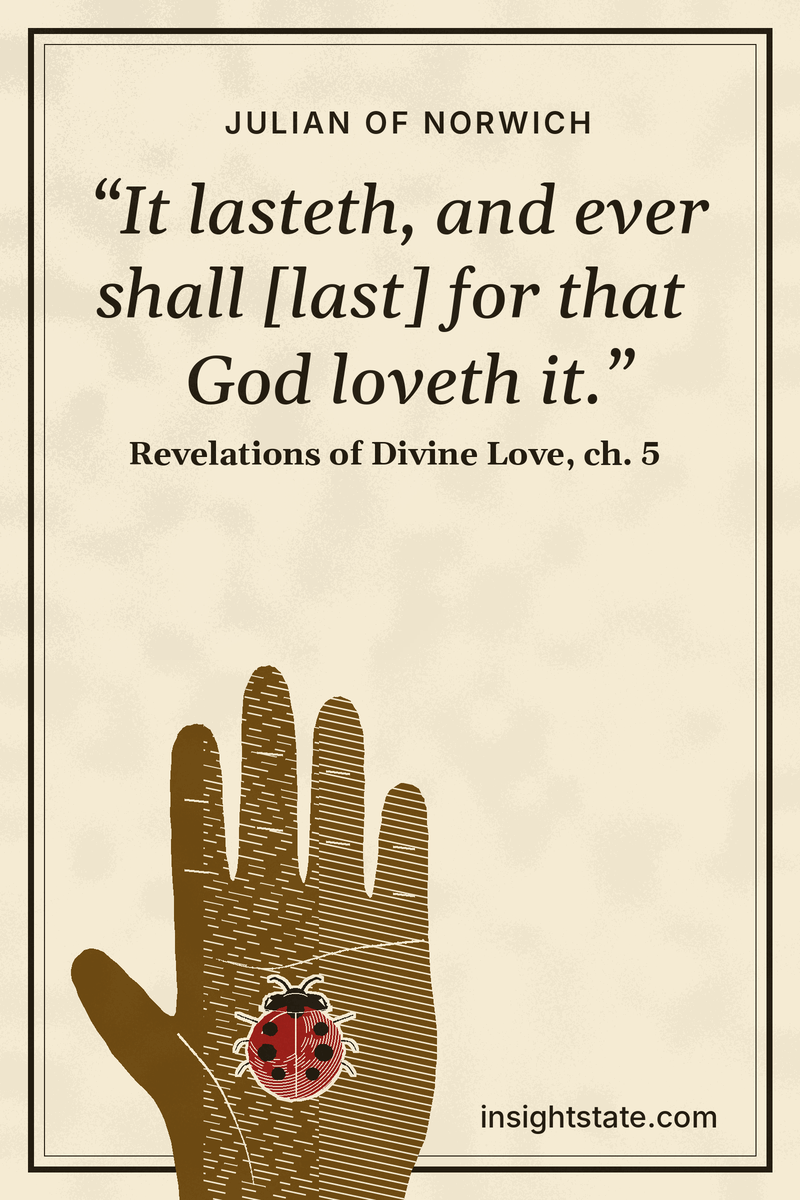
I copied that sentence into the front of my commonplace book years ago, and I turn to it every summer when the first ladybug of the year finds me.
Ladybug spiritual meaning, moment by moment
The ladybug speaks of grace that arrives in miniature. Her message changes a little with the moment she chooses, so listen for her by where you are standing when she comes.
When a ladybug lands on your hand
This is the classic visit, and it carries the gentlest meaning of all. She has chosen you as a resting place. You did nothing to earn it except stay still. I read this as a sign that a blessing is being set into your palm and that your only job is to receive it without grabbing.
William Blake opened his poem “Auguries of Innocence,” written around 1803 and kept in a private notebook for decades, with four lines that could have been written for this exact moment:
To see a World in a Grain of Sand
And a Heaven in a Wild Flower
Hold Infinity in the palm of your hand
And Eternity in an hour
The lines above follow the capitals of the Pickering Manuscript, the notebook in Blake’s own hand.
Blake was asking his reader to see the vast inside the very tiny. When a ladybug sits on your hand, you’re holding a living example of his first line. So open your fingers, keep your breath soft, and let her decide when to leave.
Finding one in your home in the cold months
A ladybug on a windowsill in November feels like a stray gift left over from summer. Spiritually she speaks of shelter. Something tender in your life is being kept safe through a hard season, even if you can’t see it growing right now. I take her as a reminder that rest is holy work.
Don’t shoo her outside into the frost. Let her find a quiet corner. She’s the easiest houseguest you’ll ever host, she won’t even look at your fridge. And ask yourself what in you needs the same patience.
Counting the seven spots
The most familiar ladybug in Europe is the seven-spot, and her spots sit on her elytra (the two hard wing cases that cover her flying wings). Christian Europe gave her a holy name long ago.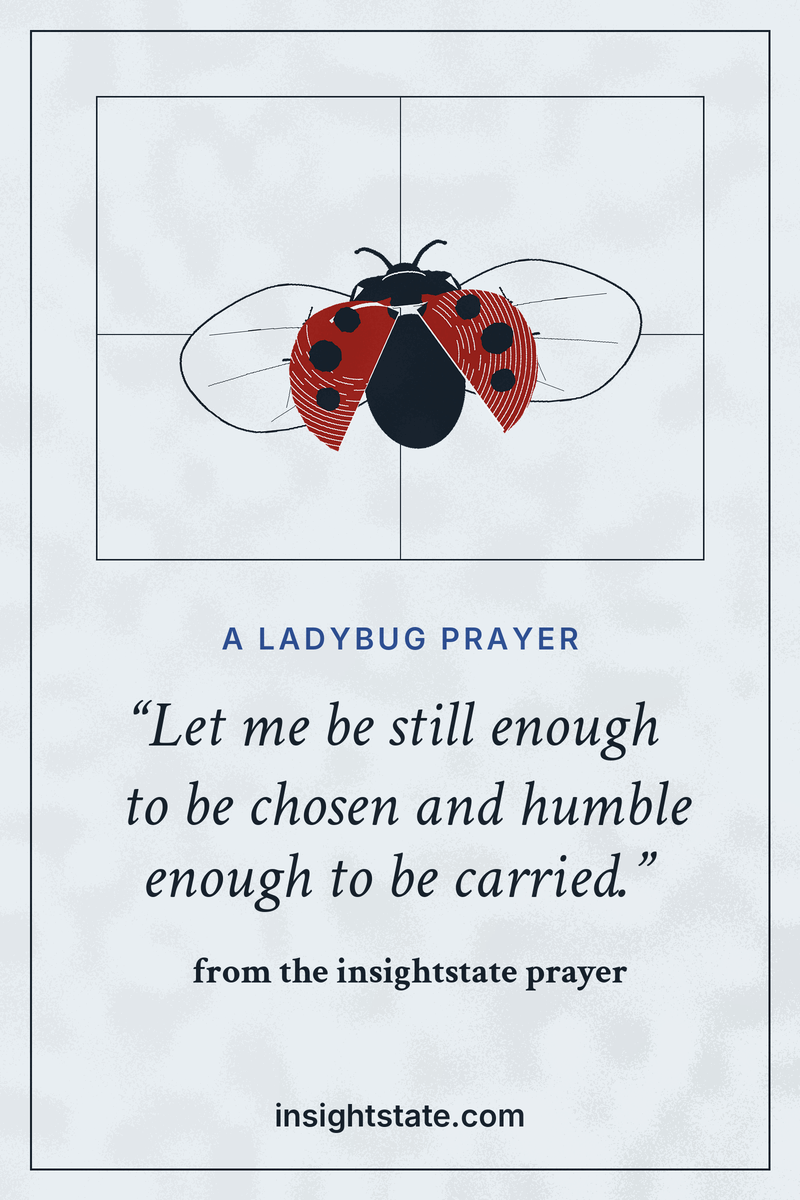
The English word means Our Lady’s bird, after the Virgin Mary, who was usually painted in a red cloak in early art. Red for her cloak. Seven spots for her joys and sorrows. The Game and Wildlife Conservation Trust records the same tradition, and the beetle’s Latin name, Coccinella septempunctata, counts the seven.
So when you see her spots, you’re looking at a tiny rosary. Joy and sorrow ride together on one back, and neither cancels the other. If you’ve been carrying grief and gladness at the same time and wondering whether that’s allowed, she answers yes.
Ladybug spiritual meaning when you’re grieving
If you’re mourning someone, a ladybug near a grave, on a sleeve at a funeral, or in the garden they loved can feel like a touch on the shoulder. Let it be that. Love doesn’t stop at death, and God has always used humble, ordinary objects to carry comfort to the brokenhearted. I won’t tell you who sent her. I’ll tell you she came, and that the warmth you felt when she did is real.
You might keep a small note of each visit, the date and where you were. Over a year those notes turn into a quiet record of being remembered, kind of like letters you didn’t know were being written to you.
When she comes while you’re waiting on a prayer
Gardeners love ladybugs because they eat aphids and other garden pests. They do it quietly, leaf by leaf. That’s how I understand a ladybug who appears in a season of unanswered prayer. Help is already at work under the leaves of your situation. Nobody has forgotten you, the garden is being tended.
Is there a prayer you’ve stopped praying because nothing seemed to move? She might be your sign to pick it back up.
What scripture says about little creatures
Scripture keeps a whole lesson for the little ones of the earth, and my favorite sits in a chapter most readers skim. Proverbs 30 is a chapter of numbered sayings.
Just before this passage comes a list of four things the earth cannot bear, all of them about pride and excess.
Then the tone turns, and the writer points to creatures you could hold in one hand:
There be four things which are little upon the earth, but they are exceeding wise: The ants are a people not strong, yet they prepare their meat in the summer; The conies are but a feeble folk, yet make they their houses in the rocks; The locusts have no king, yet go they forth all of them by bands; The spider taketh hold with her hands, and is in kings’ palaces.
Proverbs 30:24-28, KJV. Ants, rock badgers, locusts and a spider.
Not one of them is strong, and every one of them is called wise. The ladybug belongs in this company without any stretch at all. She is light enough to ride a blade of grass and she still does her work in the world.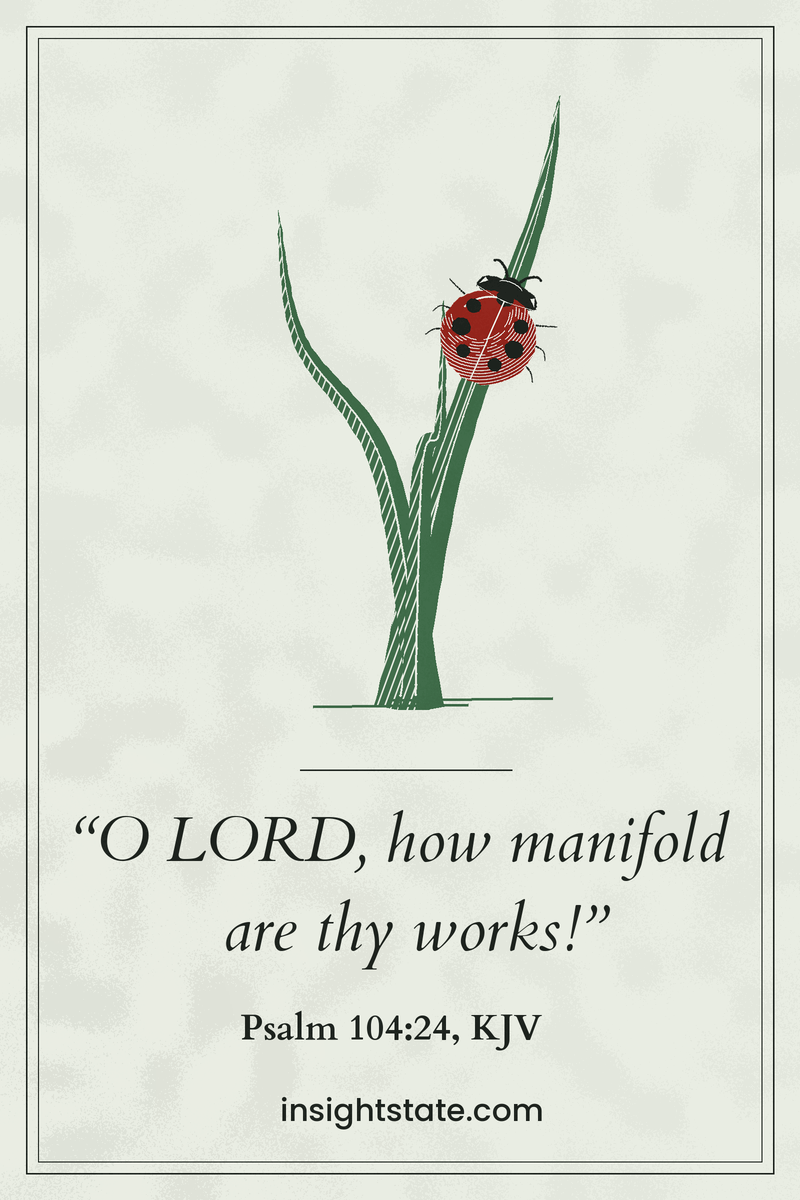
Job says something close in his darkest stretch of speeches. His friends have been lecturing him about God’s ways as if they owned the subject, and Job answers that even the animals know more than they think:
But ask now the beasts, and they shall teach thee; and the fowls of the air, and they shall tell thee: Or speak to the earth, and it shall teach thee: and the fishes of the sea shall declare unto thee. Who knoweth not in all these that the hand of the LORD hath wrought this? In whose hand is the soul of every living thing, and the breath of all mankind.
Job 12:7-10, KJV. Ask the creatures, Job says, and they’ll point you back to God. That’s exactly what I do when a ladybug lands on me. I ask her, and she points up.
And then there’s Jesus, speaking to his disciples about fear in Luke 12, telling them that not one sparrow sold in the market is forgotten before God.
He finishes with a line I’d love you to carry home: “Fear not therefore: ye are of more value than many sparrows” (Luke 12:7, KJV). If heaven keeps track of a sparrow, it keeps track of the beetle on your sleeve. And it keeps track of you.
Writers who saw heaven in small things
The ladybug’s message lives in a long line of Christian writing about the least of God’s works, and a few of those voices belong in your notebook.
Julian of Norwich, the fourteenth-century English mystic, fell so ill in 1373 that she was given the last rites. During that illness she received a series of visions, and one of them is about something light enough to sit in a palm:
Also in this He shewed me a little thing, the quantity of an hazel-nut, in the palm of my hand; and it was as round as a ball. I looked thereupon with eye of my understanding, and thought: What may this be?
That’s from chapter five of Revelations of Divine Love (public-domain edition).
She’s told the little thing is all that is made, and she wonders how something so fragile keeps from falling into nothing. The answer she hears is one of the most comforting sentences in English:
“It lasteth, and ever shall [last] for that God loveth it.” Put a ladybug in the place of that hazelnut and you have the whole spiritual meaning in one picture. She’s small, she’s held, and she lasts because she’s loved.
Gerard Manley Hopkins, a Jesuit priest, wrote “Pied Beauty” in 1877. It wasn’t published until 1918, long after his death. The first line is a spotted creature’s hymn: “Glory be to God for dappled things” (full poem at Poets.org).
Hopkins goes on to praise freckles, finches’ wings and trout with rose-colored marks. He never mentions a ladybug. But I can’t read the poem without seeing one.
Walt Whitman pushed the same idea in section thirty-one of “Song of Myself”:
I believe a leaf of grass is no less than the journey-work of the stars,
And the pismire is equally perfect, and a grain of sand, and the egg of the wren,
A pismire is an old word for an ant (Song of Myself, 31). Whitman and Thomas à Kempis lived four centuries apart, yet they agree on the point you read near the top. Whatever God made, however tiny, is finished and perfect.
The bee in the Dhammapada
The Buddhist tradition has its own teaching about a humble creature, and I find it moving beside the ladybug. The Dhammapada is a collection of verses from the Pali canon. In the chapter on flowers, verse forty-nine reads:
As the bee collects nectar and departs without injuring the flower, or its colour or scent, so let a sage dwell in his village.
That’s the translation by F. Max Müller, published in The Sacred Books of the East in 1881.
The verse describes how a monk should move through a village on his alms round, taking what he needs and harming nothing. A ladybug lives the same way in a garden. She leaves the rose untouched and takes only the pests.
I hear that as a gentle word about how you move through your own home and workplace. Can you take what you need today and leave every flower you pass a little better?
A small ritual for the next ladybug
You don’t need candles or tools for this. You need about five minutes and a ladybug willing to stay. When one lands on you, let her walk. Don’t shake her off and don’t trap her in your fist. Watch which way she climbs.
Then count her spots slowly. With each one, name something you’re carrying, a joy or a sorrow, whichever comes first. You might reach seven and you might reach two, it doesn’t matter.
When you’ve named them, lift your hand toward the light, fingertip up, and wait.
When she flies, picture her taking those named things up to God with her. I’ve done this on park benches and in my garden at home, and I always feel lighter afterward. She weighs almost nothing and somehow carries a lot.
Afterward, sit with your journal for a few minutes and write down whatever these questions stir in you:
- What small thing have you stopped noticing?
- Which sorrow and which joy are you holding at the same time right now?
- Where in your life is help already working quietly, out of sight?
- Who needs you to be a gentle visitor this week, like the bee in the Dhammapada?
Then pray, in your own words or in mine. Lord, thank you for the red messenger you sent today. Let me be still enough to be chosen and humble enough to be carried.
Keep what is tender in my life safe through every winter. Teach me to hold my joys and my sorrows together, the way she carries her spots. And when I’m afraid, remind me I’m worth more than many sparrows. Amen.
When she flies away
A ladybug never stays long, and that’s part of her grace. She reminds you that heaven doesn’t need size to reach you. It only needs you to notice. The psalmist looked at the whole teeming earth and could only say, “O LORD, how manifold are thy works!” (Psalm 104:24, KJV).
What will you say the next time one lands on you?
READ THIS NEXT: Hawk Spiritual Meaning & Symbolism in the Bible