
A hummingbird never really arrives.
One second the air beside the porch is empty, and the next there is a green spark hanging perfectly still in front of a flower, its wings humming like a held breath.
Then it’s gone.
If you were the one standing there, you probably felt it in your chest before you had a single thought about it.
I’ve kept a notebook of moments like that for twenty years, and the hummingbird pages are among the most worn.
Readers write to me about a visit at the kitchen window, about one that hovered over a fresh grave, about one that flew straight at them and stopped a hand’s width from their face.
They all ask the same thing. What was that, and why me?
So here is what I have come to believe about this tiny messenger, what scripture and a few faithful souls have written that fits it, and a short practice for the next time one stops in front of you.
But ask now the beasts, and they shall teach thee; And the fowls of the air, and they shall tell thee: Or speak to the earth, and it shall teach thee: And the fishes of the sea shall declare unto thee. Who knoweth not in all these That the hand of the LORD hath wrought this? In whose hand is the soul of every living thing, And the breath of all mankind.
Job 12:7-10, King James Version (read it on Bible.com)
Job says these words in the worst season of his life.
His friends have been lecturing him about the Almighty as if He were a theory to be argued, and Job answers by pointing out the window.
The animals already know whose hand made them. A bird can teach what a sermon can’t, and that is the lens I bring to each hummingbird I meet.
The hummingbird spiritual meaning, in plain words
The hummingbird is a messenger of joy that asks you to be present.
That’s the center of it.
Everything else I’ll tell you grows out of those two words, joy and presence.
Look at how it lives. It hovers, which means it holds itself in one place by moving with tremendous effort, and it feeds on what is sweet.
Its throat can flash ruby in one turn of the head and look almost black in the next, because, as the Cornell Lab of Ornithology explains, much of that color comes from the structure of the feather and changes with the angle you see it from. I take that as a quiet teaching.
The beauty is there the whole time, and you see it when you turn toward the light.
In my own energy work I connect this messenger with the heart chakra (anahata in Sanskrit, the energy center in the middle of your chest that holds love, grief and your ability to receive).
When a hummingbird crosses your path, you are being asked to open a little wider and take in some sweetness again. Most of us are very good at giving and quite poor at receiving. This one is a specialist in receiving.
When a hummingbird hovers right in front of you
This is the encounter people remember for years. It stops at eye level, maybe a foot away, and seems to study you. I read it as an invitation to stop, plain and direct, from the busiest creature in your yard, which has just chosen to go quiet in front of you.
The message is the one God gives in Psalm 46:10: “Be still, and know that I am God” (KJV). Whatever you were rushing toward can wait for one breath.
What were you thinking about in the second before it appeared? Write that down. In my experience it tends to show up right on top of the thought that needed interrupting.
When one visits after someone you love has died
This is the letter I get most. A hummingbird comes to the window the week after the funeral, or lands on the feeder your mother filled every summer, and your heart says it’s her. I won’t tell you who sent it, because that knowing belongs between you and God. But I believe the love you feel in that moment is real and that it runs both ways. Love does not stop at the edge of a life.
So receive it. Say thank you out loud if you want to. You don’t have to prove anything to anyone, and you don’t have to wait for a second sign before you let the first one comfort you.
A hummingbird at your window or door
A threshold is a place of change, so a hummingbird at the door or tapping near the glass marks a crossing in your life. Something sweet wants to come in. Sometimes that’s a person, sometimes it’s an opportunity you’ve kept at arm’s length. And sometimes it’s your own joy, which you’ve left standing outside like a visitor you weren’t ready to welcome.
ALSO READ: [related article title]
Dreaming of a hummingbird
A hummingbird in a dream tends to come when the waking self has been running on empty. If it was feeding, your soul is asking for nourishment, real rest and real pleasure, the kind that doesn’t have to be squeezed between tasks. If it was trapped indoors and beating against a window, look honestly at where your joy feels caged right now. A hummingbird resting in your open hand is one of the kindest dreams I know of, and it speaks of trust given and trust returned.
Seeing one sitting very still
Here’s what moves me about this little one. A hummingbird can’t keep burning all night, so on cold nights it drops into torpor (a deep, slowed state close to hibernation).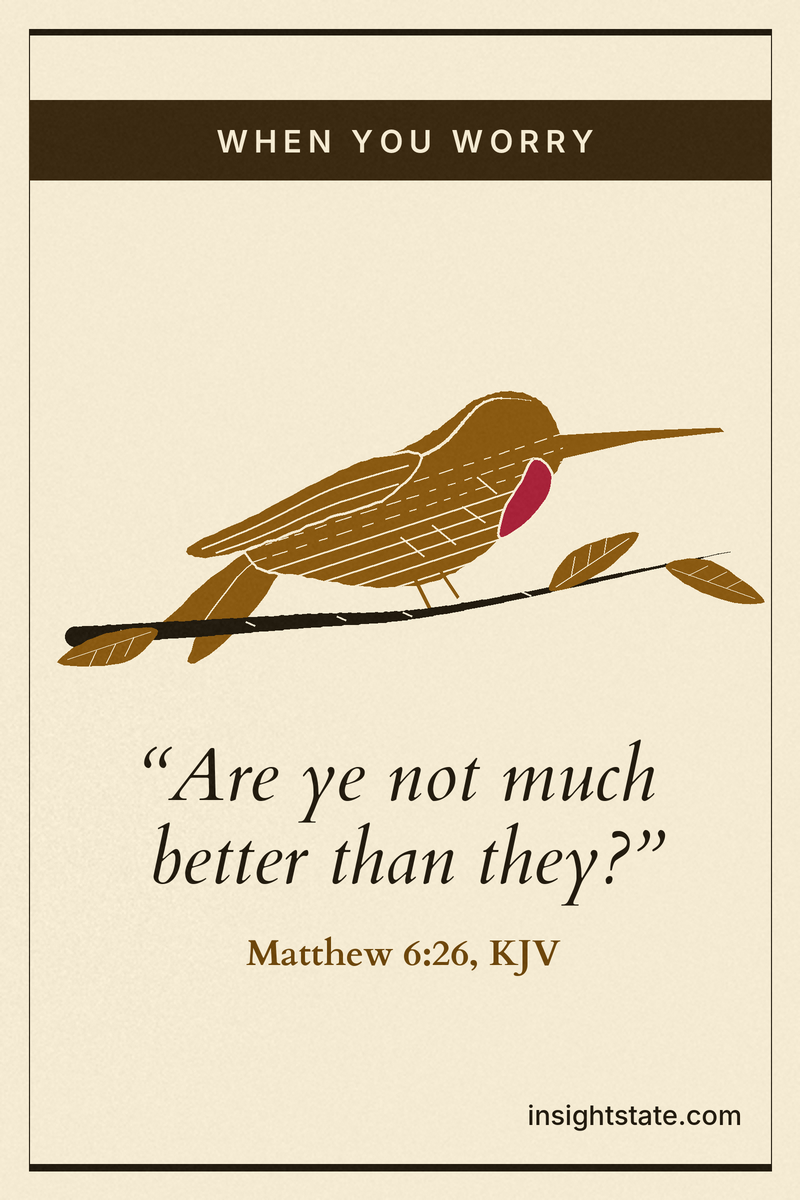
According to Journey North, its pulse can slow from about 500 beats a minute to fewer than fifty. People sometimes find one hanging motionless on a branch at dawn and think it has died. It hasn’t, it is resting so it can fly again.
If you see a hummingbird sitting still, take it personally. Even the busiest heart was made to rest. God built Sabbath into the week before anyone had earned it, and the smallest bird in your yard keeps that law each night.
The colors it shows you
Pay attention to which flash of color caught your eye. Green, the shade of most hummingbird backs, belongs to the heart chakra and to growth, so a green visitor at your feeder points to healing in a relationship or in yourself. Red, from a ruby throat or a red flower it chose, speaks of life force and affection ready to be spoken. A violet or blue flash lifts the message toward prayer and toward the higher chakras. It wears those feathers for its own reasons, and God chooses the moment you notice them.
The hummingbird as your spirit animal
If this messenger keeps finding you, at feeders, on cards friends send, in a stranger’s tattoo, it may be one of your guides. Those who walk with the hummingbird tend to be light-bringers who carry other people’s moods along with their own, and they give fast and rest late.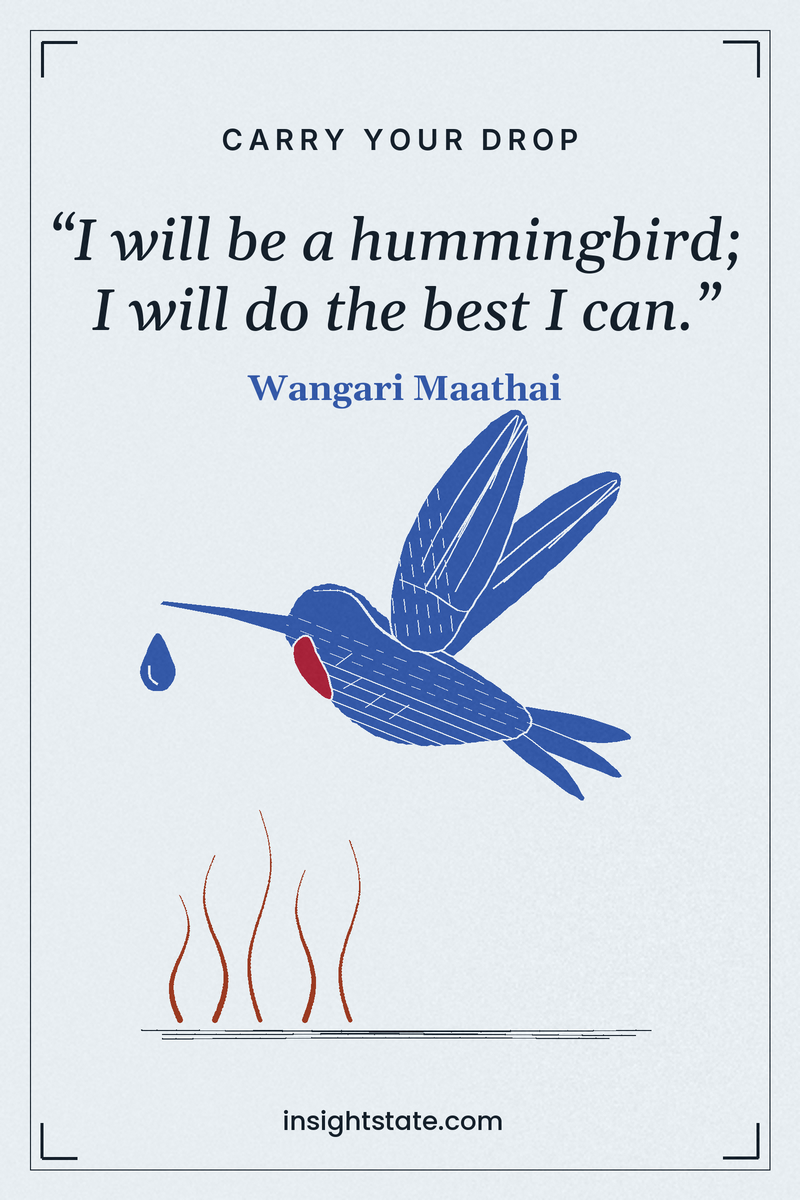
Its lesson for them is the same every time. Feed yourself on sweetness and rest without guilt. And stop apologising for being small, because I have yet to see a hummingbird apologise for visiting the same feeder four times in an hour.
What scripture says about little winged things
The hummingbird never appears in the Bible. It is a bird of the Americas only, as Britannica notes, so the writers of scripture never saw one. But Jesus spoke about birds in a way that fits it perfectly.
Behold the fowls of the air: for they sow not, neither do they reap, nor gather into barns; yet your heavenly Father feedeth them. Are ye not much better than they? Which of you by taking thought can add one cubit unto his stature? And why take ye thought for raiment? Consider the lilies of the field, how they grow; they toil not, neither do they spin: and yet I say unto you, That even Solomon in all his glory was not arrayed like one of these.
Matthew 6:26-29, King James Version
These verses sit in the Sermon on the Mount, in the middle of a teaching about worry. Jesus puts a bird and a flower side by side and tells anxious people to look at them.
Every hummingbird you’ve ever seen is that sermon in motion, a tiny creature drinking from a flower, fed and clothed by a Father who does not forget the small. When you’re lying awake over money or the future, I think he would point you to the feeder.
The second passage is one almost nobody connects with hummingbirds, and I think it belongs to them more than any other.
My beloved spake, and said unto me, Rise up, my love, my fair one, And come away. For, lo, the winter is past, The rain is over and gone; The flowers appear on the earth; The time of the singing of birds is come, And the voice of the turtle Is heard in our land; The fig tree putteth forth her green figs, And the vines with the tender grape Give a good smell. Arise, my love, my fair one, and come away.
Song of Solomon 2:10-13, King James Version
The “turtle” here is the turtledove. In the Song, the lover calls his beloved out of the house because the cold season has ended and everything is coming back to life.
In the eastern United States and Canada, the ruby-throated hummingbird returns with the first warm flowers, having wintered in Central America, Mexico and Florida.
For many readers, the first hummingbird of spring is the moment they feel “the winter is past” in their bones. If you’ve been through a long winter of the heart, let its return be a call to rise up and come away.
Voices that saw the Creator in the hummingbird
John James Audubon painted the ruby-throated hummingbird as Plate 47 of The Birds of America, a family of them darting among trumpet-flower vines.
In the essay that goes with the plate he called it a “glittering fragment of the rainbow” and asked his reader who could watch it without turning “with reverence toward the Almighty Creator.”
He answered himself. Nobody could, he wrote. I find it moving that a working naturalist, a man who handled birds daily for decades, reached for worship anyway when he came to describe this one.
Emily Dickinson wrote a hummingbird poem that never names the bird. Her early editors gave it the title “The Humming-Bird,” and here it is whole, all eight lines of it:
A route of evanescence / With a revolving wheel; / A resonance of emerald, / A rush of cochineal; / And every blossom on the bush / Adjusts its tumbled head, — / The mail from Tunis, probably, / An easy morning’s ride.
Emily Dickinson, “A Route of Evanescence”
Evanescence means a vanishing, and cochineal is a crimson dye.
According to the Morgan Library, she sent copies of this poem to many friends, Helen Hunt Jackson among them. I keep it near me because it teaches the right way to see a hummingbird. You barely catch it. The flower is still moving after the bird has gone, and that trembling blossom is how you know a visit happened.
Saint Francis of Assisi never met a hummingbird either, but The Little Flowers of St. Francis, the old collection of stories about him and his friars, records the sermon he preached to a field full of birds. In W. Heywood’s 1906 translation, he ends it like this:
Guard yourselves, therefore, my sisters the birds, from the sin of ingratitude and be ye ever mindful to give praise to God.
The Little Flowers of St. Francis, chapter XVI, tr. W. Heywood
Gratitude is the hummingbird’s whole posture. It drinks and moves on from bloom to bloom, and it never builds a storehouse. When one visits you, Francis’s little sermon is a good thing to say back.
The voice I return to most is Wangari Maathai, the Kenyan environmentalist who won the Nobel Peace Prize in 2004 and whose Green Belt Movement planted trees across Africa.
She loved to tell an old story about a forest fire. The animals stood at the edge watching it burn, while one hummingbird kept flying to the stream and back, dropping water on the flames one beakful at a time.
When the bigger animals mocked her, the hummingbird said she was doing the best she could. Then Maathai would add her own line, which the Green Belt Movement keeps on its pages: “I will be a hummingbird; I will do the best I can.”
That is a believer’s answer to every problem bigger than you. Nobody handed you the whole fire. Your part is the drop in your beak, carried faithfully, and the rest belongs to God.
The hummingbird among the Aztecs
Long before the hummingbird reached my notebook, the Mexica people, whom we call the Aztecs, held it in great honor. Their highest deity, Huitzilopochtli, carried it in his very name, which comes from the Nahuatl word huitzilin, “hummingbird.”
According to Britannica, they believed that warriors who died in battle first joined the bright company of the sun, and after four years went to live forever in the bodies of hummingbirds.
That belief belongs to them, and I hold it with respect.
What I carry from it is the instinct they shared with grieving people in every age since. They looked at the brightest, quickest thing in the garden and saw courage that had passed through death and lived on. As a Christian I find that very close to my own hope, that death does not get the last word over anyone dear to us.
A small practice for the day a hummingbird finds you
You don’t need a garden for this. A single red flower in a jar on the windowsill will do, or a candle if that is what you have. Sit somewhere you can see it, put one hand flat on the middle of your chest, and breathe slowly until your shoulders drop. Picture a soft green light gathering under your palm, because green is the color of the heart chakra, and let it spread a little further with each breath out.
Then name one sweet thing from the last day out loud, something tiny, and let yourself enjoy it for a full minute without fixing anything about it.
That’s the whole ritual. It takes about five minutes, and I’d do it for seven mornings following a hummingbird visit, the way you’d answer a letter. Afterwards open your notebook and write for a while with these prompts.
- Where in my life am I hovering, working hard just to stay in the same place?
- What sweetness have I stopped letting myself taste?
- Whose love do I feel near me lately, and what would I say to them if I could?
- What small drop of good is mine to carry this week?
Here is a short prayer I say on those mornings. Change any word you like.
Lord of every small and shining thing, thank you for the visitor at my window.
Teach me to be still in the middle of my rushing and to taste the good you put in front of me.
Hold the ones I love who have gone ahead of me, and hold me while I miss them. Give me the courage to carry my one drop of water, and enough rest to fly again tomorrow. Amen.
The next time you hear that small hum near your ear, leave your phone in your pocket.
Stand quietly and let it look you over. As you read near the middle of this page, Dickinson saw the blossom adjust its tumbled head after the hummingbird had gone. What in you will still be trembling, in the good way, after this one leaves?
READ THIS NEXT: Ladybug Spiritual Meaning & Symbolism